
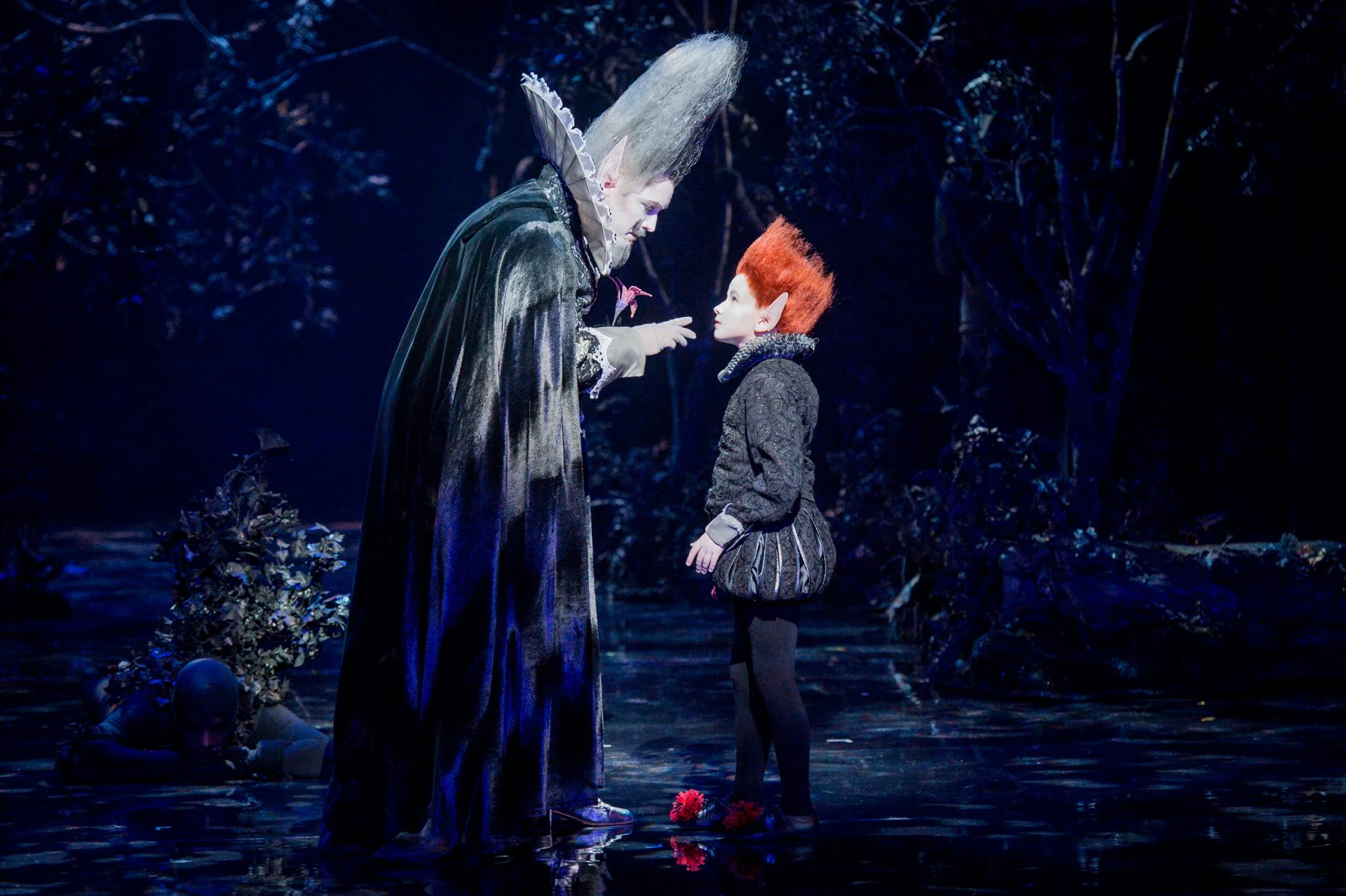
Click here to listen to the Podcast (Duration: 23 mins)
Edward Seckerson: Marisol Montalvo, Nathan Gunn, you are the main protagonists in Love and Other Demons, and you’re brought together in a very unlikely and very fateful union. This is a quite a small novel, the original by Gabriel García Márquez, but it deals with huge issues. First of all take us through a little bit of the narrative side of the piece, so people get a rough idea of where we are with the two of you.
Nathan Gunn: Well when I first read it I thought ok, it’s interesting because it follows a fairly traditional, linear pattern, how stories are generally told, that’s how its done. But it adds all sorts of other little elements to it that make it very strange. It begins with a letter from the author as if he’s remembering something that had actually happened to him. So those things get all sort of confused. And then what eventually happens is that we are told a story about a girl who is thought of as a saint by those around her for performing miracles. And then, once that happens, you realise that she was bitten by a rabid dog, the story begins to unfold, and you get the description of a girl who’s described as either a saint or possessed by demons, who does miracles or is it black magic? One who’s a seductress or is she an innocent child?
ES: Well you know, perceptions, the world we live in, you know how...
NG: There’s another element where, what it does it turns (and this happens in the opera) it turns the perception of the audience inside out, upside down so what seems common place in reality all of a sudden is not, and what is not reality like these dreams, that play a big role in this, seem to be the only thing that can tell what the future’s going to hold; odd things like that. We have to remember to that its takes place in an area that is like Columbia and the 18th century devout Roman Catholics are brutal, ignorant and violent. And then the progressive thinkers are eventually scorned for their inability to believe in magic. It all twists around.
ES: Yes, because there is this aspect of it where we demonise things we don’t understand, and cultures we don’t understand.
Marisol Montalvo: That’s where I’m more from. I’m less about the magic and the love, and more the reality of what the book talks about. The misunderstanding of cultures; she’s a little white girl that grew up with slaves because her parents didn’t want her so there are two aspects. She didn’t have any love. So yes, in the end, I can believe she died of love because everything she wanted and hoped for, never came true for her. But I think the reason about her demise was through I think the misunderstanding of her upbringing from the slaves, and of course to whites, they didn’t understand the black culture or the slave culture - Yoruba - and they thought that she was possessed and she had to be exorcised to get those demons out of her. They didn’t understand why she believed in these deities.
NG: Yet, when they dig up her body accidentally, her hair has continued to grow and is young and alive and youthful, as her body’s just bones. Was she a saint? Was it when they said your hair will grow until your wedding day? Is that magic? Was she possessed? I mean who knows?
ES: Vladimir Jurowski, to me, love and other demons is about the demonisation of things; cultures we don’t understand, celibacy we don’t understand, all these various things, love we don’t understand… is that how you see it?
Vladimir Jurowski: Well I absolutely agree with that. I think the main motto of the piece is pronounced by probably the most sympathetic and sober character,Doctor Abrenuncio, who is a bit of an outsider himself. He proclaims that the only demon which exists is the demon of our innermost solitude. And if you look at the characters in this piece, apart from the Sierva Maria, the little girl, everybody else is deeply lonesome, and suffering from solitude, and therefore falling into various traps set by the demon of this human solitude. Getting possessed. Being taken by the demons of either fear, or suppressed sexuality, or ignorance, or intellectual ignorance. When we are calling things which we don’t understand, things which are foreign to us, calling them demonic or devilish. And, the only character, as I said already, who is not possessed by the demons is the one who eventually suffers for everyone’s sins, is taking everyone’s sins onto her soul, becoming a kind of maybe evangelist parallel, kind of a Jesus; is Sierva Maria. This girl, who grew up in a different community, she grew up surrounded by black slaves and their rituals, their beliefs, their traditions. So she doesn’t fit into this white, Catholic, world, and is being forced into it, and as a result, dies.
ES: David Pickard, it was conceived this piece for Glyndebourne, very specifically. Tell us briefly about its genesis, and whether your first encounters with Peter Eötvös were as a conductor or as a composer as well, presumably both?
David Pickard: Well actually no. My first encounter was with him very much as a conductor because I started here in the summer of 2001, and I think virtually my first day at Glyndebourne was the opening night of The Makropulos Case conducted by Peter Eötvös. And to my shame, I didn’t really know his works as a composer until Vladimir Jurowski gave me the CDs of the Three Sisters and said ‘you should go away and listen to this, this is a piece I think we should do at Glyndebourne’ And, I listened to it and I loved it, and I got speaking to Peter and he got very excited because, amazingly for somebody as prolific and as much performed as he is, he has never had a staged opera performance in the UK. In fact, the only operatic performance of his was a concert performance of the Three Sisters at the Edinburgh festival a few years back. And, from having started this thought that we might do an existing opera of his, it didn’t take us too long to think well why don’t we actually ask him to write something new for us? And actually, one of the interesting things was my children were, at that point, just starting to read the Philip Pullman trilogies and for some reason I do remember thinking ‘ah, this would make such wonderful operatic material’. I still think they would actually. It was only a flippant thing. I remember giving the book to read. But he had a book for me, which was Of Love and Other Demons, by Gabriel García Márquez and everything that he said about the book when I’d read it and its appropriateness for operatic treatment and the rightness of it for him and the rightness of it for Glyndebourne, rang true. His starting point, interesting for a piece which is - you know pretty violent, and pretty strange and weird and is full of magic realism - was that it was a love story, and that’s what really attracted him to it. And of course at heart it is a love story. He felt that it was the sort of piece that, in Glyndebourne, where one has, you know, a long interval in the middle, and you have people coming here away from London to a different sort of setting, he felt it was the sort of thing that actually would really hold audiences and be sufficiently dramatic to hold people’s attention when they came back after a long supper interval and you know he could see this working in his head.
ES: The buzz is extraordinary on it, I’ve been talking to one or two of the participants, and the conductor of course, and everybody’s saying that people will need the dinner interval to fortify themselves, because the climax of the piece is pretty shattering. This is the big exorcism at the end. Theatrically it sounds like its going to be quite an eyeful, and quite an earful at the same time.
DP: Yes it will, and you know one of the things that Peter was most keen to be involved in from the beginning was not the conductor interestingly - I remember Vladimir saying: ‘oh does Peter mind if I conduct it’, because I think this is the first world premiere of any of his operas that Peter hasn’t conducted himself - but we had long long discussions about the director, and I do remember sitting in the office in which we’re sitting now, and Peter saying; the person I want to direct this is Quentin Tarantino. And there was a brief moment when we were sort of scanning through the odd agent’s book thinking how do we get hold of Quentin Tarantino? I think we might have gone down that line briefly at one point but what he was really saying was that is the imagination I want; I want that very violent, that very visceral, that very passionate sort of imagination.
NG: In the story as in the opera, it’s affirmed that we need love in our lives, and we need it, but what is questioned is our ability to actually handle it. And that’s what is certainly my character’s demise. Father Delaura is bookish. We’ve talked about this, as we’re still developing all of this and I know that Helmut, the costume designer, sort of disagrees with me about this, but I don’t think he is tormented at the beginning. I think he is enjoying the books that he gets to read, some are forbidden books, some are not; he enjoys intellectually challenging himself, and then he’s asked to perform an exorcism that he is not exactly sure should happen, but he definitely knows he doesn’t know how to do. And the Bishop is at a point in his life where I think they’ve decided he is questioning a bit of his faith, and he’s becoming very fervent ironically, and he decides definitely an exorcism has to happen and he chooses to have Father Delaura do it, even though he doesn’t know the ritual and he’s not skilled. He says well, use your learning and inspiration, which is heretical in the Catholic Church, but that’s what he says, and so Father Delaura decides ‘alright I’ll try this’ and he’s put into this situation where he’s using inspiration and his profound learning in a place where it shouldn’t be. And I think that opens the door to this demon that gets a hold of him which is love.
VJ: The love story which is described in the piece is a very strange love story because first of all, it’s taking place between a 36-year-old priest, a scholar, an intellectual, and a 12-year-old girl who’s an innocent being, almost like some kind of an animal. So, by definition, this can’t be possible and can’t go well. And then we also discover that Delaura, although deeply sympathetic because of his humanity, is suffering from his own demons, and those are the demons of the suppressed emotions and suppressed sexuality. And then, unwillingly he uses Sierva, to drive out these demons out of him, and it ends in this absolutely shocking scene of self-flagellation at the end of Act 1, which is becoming a climax of Delaura’s development as a character, after which everything, including the love story with Sierva, becomes seconded.
ES: It seems to me that everything in the piece, opens itself to all our prejudices as well, so if you go in and perceive the love, perhaps a pure love, between this 36-year-old priest and a 12-year-old girl, people are going to be immediately saying ah, paedophilia and so you get another dimension added. It’s how you perceive these things; this is what the novel is trying to do and this is what the opera is trying to do by the sound of it. Is it going to play tricks on the audience, are the audience going to be, you know, constantly torn between wondering whether this is really happening or whether it’s a dream.
VJ: I think this is the main, if you like, game in this piece; that we don’t know, until the very end, what is the reality. This conscious blurring of the border lines between the reality, dream, memory and imagination is something which is definitely inspired by Garcia Márquez himself and his magic realism. And actually some of the themes, including this children getting involved with grown-ups in some kind of imaginary love-affairs, is a recurring theme of his writings. But I don’t find it, I personally don’t find it more disturbing than some of the sequences from Federico Fellini films, where young boys are getting excited about the enormous breasts of aging women. It is natural, in a certain way, if you take the rather odd, weird environment as a reality.
ES: It’s interesting, Eötvös in Hungary, wrote a lot of incidental music for theatre, in his younger days, it sounds like…
VJ: and film music…
ES: and film music, it really sounds like we’re in for a highly theatrical experience. I’m getting quite excited about it hearing the main protagonists talk about this awesome exorcism at the end, which sounds extraordinary. But everything you’ve said suggests that this is a man of the theatre who is…
VJ: But who is at the same time a great composer. Because, there is not a single element which is used just for an effect; it is all incorporated extremely genuinely and logically into the system of musical language, which he’s set for this piece.
ES: Eötvös himself says that he doesn’t feel he has any particular musical style. Do you think that’s true?
VJ: Well, it is very difficult to compare his music to other musics. It is even difficult to compare this particular piece by Peter Eötvös to other pieces by Peter Eötvös. Because I think one of the main features of his creativity is that he reinvents and redefines himself with every piece.
ES: Like an actor.
VJ: Like an actor, trying to adopt a completely different type of behaviour and even sound of the voice. I think in that he is close, I wouldn’t say similar, but close to two great masters of the 20th century. One is Igor Stravinsky who, as we know, kept reinventing until his dying day, and somehow, almost every single piece by Stravinsky turned into a masterpiece, of its own kind. And then the other one is a compatriot of Peter Eötvös; Georgi Ligeti, who also never got tired of throwing himself into new stylistic adventures. And by saying stylistic adventures, I don’t meant that he is adopting some other styles, or like some other people is mixing, throwing the styles into the mix, in a kind of poly-stylistic way. But I think that Peter Eötvös simply, as a composer, is completely free of prejudices and superstitions. There is not such a thing as a taboo, but there is such a thing as game rules, and he is reinventing his game rules and setting it for himself, every single time. And in that way, to quote Pushkin; he’s joining actually a very good company because Pushkin always insisted that the creative artist should only be judged following the same laws and rules that he has created for that particular work.
DP: The very first thing that we did when we were casting the opera, was we put a number of singers in front of Peter, and he wanted to hear their voices and he wanted to hear them speak, and then he wrote the music for them. I remember with Delaura, the central character, he said to us ‘I need somebody with a beautiful voice, and I need somebody whose going to be a very unlikely person to be a priest, because I want them to be too good-looking to be a priest’. And we showed him a video of Nathan Gunn who of course is a very handsome man. Last time he was here, he was sort of swinging around as Marcello in Bohème - most unlikely person to end up playing somebody with a dog collar - and that was exactly what he wanted. All the characters come through in the way that they sing, and yes, some of the music is incredibly stratospheric; some of it is full of wide leaping intervals. And some of it is beautiful and very tonal, and very simple. I couldn’t agree more with Vladimir that in a way, I can’t categorize this piece any more than I could categorize Le Balcon or Three Sisters, because they’re all three different. Just as Le Balcon for instance and Angels in America, drew very much on the sort of jazz side of things for Peter; this seems in a way to be almost harking back to operatic traditions, and one hesitates to use the word lyrical in a way for audiences, because this is still a piece of 21st century music, and you know if I start saying Bellini to people and they then come and here this piece, you know I couldn’t lie and say it’s going to sound like Casta diva because it isn’t. But there are echoes of the past, both in terms of opera and other classical music.
ES: Just the two of you, for people who are coming to this for the first time, give us a couple of pointers maybe of what to look out for, key moments that might reveal something to them.
NG: Marisol gets naked at one point…
MM: I’m going to get naked, for the innocent young body…
NG: she’ll do that…
ES: well that’ll go well in the Independent!
MM: It’s about innocence, it’s about purity, you’re not ashamed really. At least this child isn’t, you know when she goes with the slaves, slaves are not… you see how the Africans dance, even the children; they move every aspect of their body. They’re not ashamed of their body.
NG: First of all, I think its going to be visually spectacular. The set is incredible and we’re using scenes that are filmed before we go on stage, and the use of cameras I think on stage too to get some close ups that are projected onto the walls which is taking place in basically it looks kind of like a cathedral that’s being excavated, which is representative of the beginning of the book. That is wonderful, I was mentioning before the scene, the flagellation scene, where his aria at the end of the first act. You’ll see one side of it which is me on stage performing and kind of giving into that idea of love and sexual relationship with this girl; and then the other, projected scene that we do before which is him actually beating it out of him. So you’ll have both elements there and what’s wonderful is that you never know what the reality is. Like I said, are the dreams really the reality in this? It’s definitely about love being a demon for us and it’s definitely about affirming, like I said, that it’s important in our lives, confirming that actually. Yet it’s a slippery slope that can lead to something awful. Everyone is ruined in this opera at the end; everyone loses; she dies and she’s the most innocent, there’s a great scene at the end where the exorcism happens, where the Bishop finally does it, it’s awesome. There are wonderful scenes with the African slaves and the African language, Yoruba is it?
MM: yes, and we dance a bit…
NG: It’s great. It’s really great, and it will be visually and aurally spectacular. You know the point of an opera is that you communicate these emotions so effectively through music that you forget you’re listening to music, and I think he does that. It reminds me always of that Thomas Mann quote, Death in Venice where he says beauty is one element of the sublime that we can both perceive and endure. Garcia Marquez is in this story talking about love, and talking about how it is an element of the sublime that we can perceive but not endure. And in a sense the audience is going to be exercised when they’re watching this because it’s in a way torturous because you just don’t know.
MM: It’s tragic… just tragic.
NG: You’ll love it.
VJ: Obviously it’s not a piece to impress millions, it is a piece which will appeal to people with a certain interest in certain themes in theatre and in life, and in music, but for those who care about human relationships and human emotions and also for those who have an interest in things beyond the daily routine, beyond what we call normal, for people who are interested in interactions of dreams and reality, this piece will have a lot to offer.
* Please note that due to ill health Marisol Montalvo has withdrawn from the production. Her role will now be sung by Allison Bell.
You may also be interested in:
Glyndebourne Festival 2008 Podcasts
Love and Other Demons video interviews
What did you think? audience feedback page