


Synopsis
Discover the story of Stravinsky's The Rake's Progress
Act I
Tom Rakewell, a young and impecunious country gentleman, is in love with Anne Trulove, but her father, the squire, though anxious for their happiness, secretly doubts Tom’s strength of character. His suspicions are confirmed when Tom refuses his offer of steady employment in the city. Tom is content to put his trust in Fortune. A stranger, who announces himself as Nick Shadow, suddenly arrives with the news that an unknown uncle of Tom’s has died and left him a fortune. Tom must go at once to London to wind up his uncle’s estate and Shadow offers himself as Tom’s servant and guide through the intricacies of London life. The question of his salary can be decided in due course – a year and a day hence. Tom shall pay him what his services prove to have been worth. Tom takes leave of Anne and her father and sets off with Shadow to London.
Shadow introduces Tom to some of the bawdier attractions of the big city, teaching him a new creed: to be guided by instinct rather than the rules, and to seek pleasure above all things. Tom is schooled in Shadow’s lessons by Mother Goose, but when he struggles to banish his memories of Anne, the older woman decides to take him in hand, and leads him off to introduce him to pleasure.
Months have passed but Anne has heard no news of Tom. She senses that Tom needs her and resolves to go in search of him in London.
Act II
Tom is disillusioned by his life in London and seeks vain happiness. Shadow exhorts him to marry Baba the Turk, the new sensation of Giles’ Fair. Only if he acts freely he can be happy. To be free he must defy the tyranny of appetite and conscience – the bearded Baba is the antithesis of appetite and he owes her no duty. She is therefore the perfect agent for his happiness. Tom allows himself to be persuaded by Shadow and sets off to woo and win her as his bride.
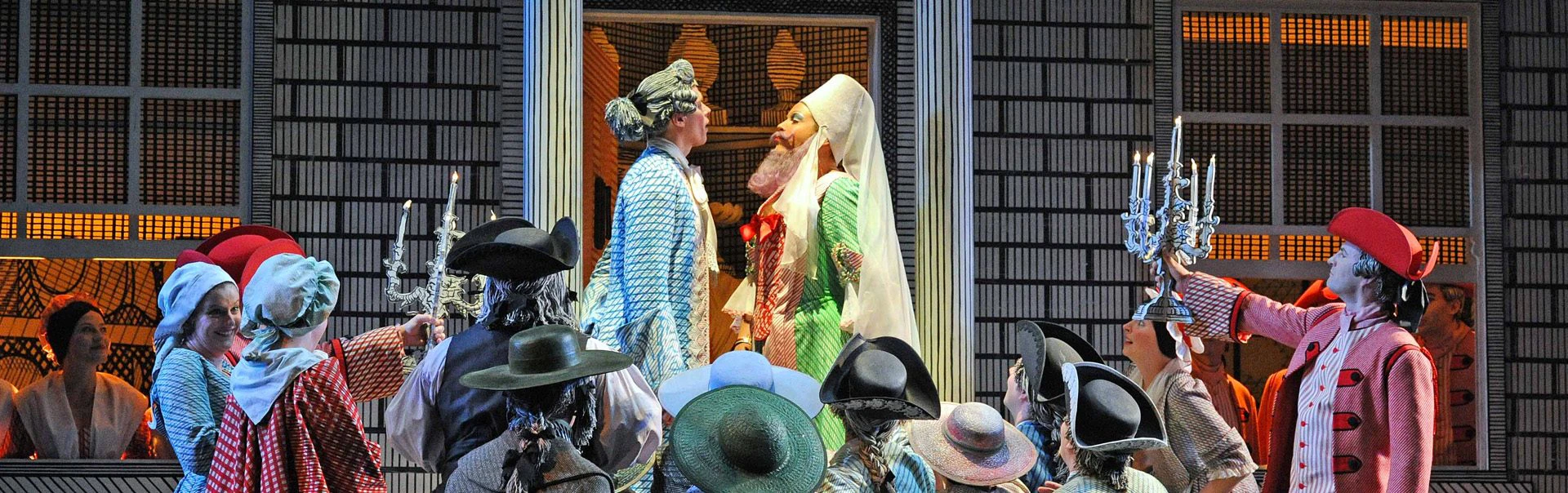
Anne finds her way to Tom’s house and sees him arrive home escorting a closed sedan chair. She greets him, but he begs her to return home and forget him. London has no use for her virtue. Anne reaffirms her love for Tom but leaves him, shamed, when she learns that the impatient occupant of the sedan chair is Baba the Turk, now his wife. Tom leads veiled Baba to the house, as the townspeople crowd around the door begging for a glimpse of her.
Baba sits a breakfast with Tom among the presents given to her on a series of triumphant European tours by her countless admirers. Tom is bored and infuriates her with his indifference. She accuses him of retaining his love for Anne and rages until Tom silences her. Then he relapsed into sleep – the last refuge of the bored. Shadow now prepares to complete Tom’s downfall by adding financial disaster to his moral and domestic ruin. He wheels in a fantastic, bogus machine for converting stones to bread. Tom wakes and tells Shadow that he has been dreaming of just such a machine, believing that it will cure poverty and bring happiness to the wretched. Thus with good deeds, he may again be worthy of Anne’s love. He leaves to devote all his energies to this noble and philanthropic scheme.
Act III
Tom’s financial bubble has burst, bringing ruin to himself and countless foolish investors. A crowd of inquisitive townsfolk flocks to attend the auction of his belongings. Anne arrives to ask news of Tom, but no one can tell her where to find him. The auctioneer, Sellem, begins to auction the contents of the house. In due course he offers a mysterious object. It is Baba, who springs to the defence of her belongings, unconscious of the intervening time since Tom silenced her. Tom and Nick are heard singing from the street, mocking Baba. Anne returns at the sound of the voices. Baba tells her that Tom still loves her and that her love may still save him. Anne rushes out to look for Tom, and Baba determines to go back to her true profession, the stage.
A year and a day have passed since Shadow entered Tom’s service. He now claims his wages, Tom’s soul. An open grave is waiting. He first offers Tom a choice of death by poison, steel, rope or gun, and then proposes that they play cards to decide his fate. Shadow attempts to cheat, but memories of Anne inspire Tom to win the game. Shadow is enraged at being outwitted, but though cheated of Tom’s soul, takes his revenge by striking him with insanity.
Tom is confined to Bedlam. He thinks himself to be Adonis, and when Anne comes to visit him, believes that she is Venus, whom he has long been seeking. He asks her forgiveness for so long disdaining her love. She comforts him and sings him to sleep with a lullaby. Her love is unaltered, but realizing that she can no longer help him, she sadly agrees to return home with her father. Tom wakes to find that Venus has gone and his heart breaks.
The principals join in pointing out the moral of the fable, that the Devil finds work for idle hands, and that includes us all.

Watch The Rake's Progress
Glyndebourne Encore
The 2010 production of The Rake's Progress is available to watch on demand by subscribing to Glyndebourne Encore - our streaming service.


